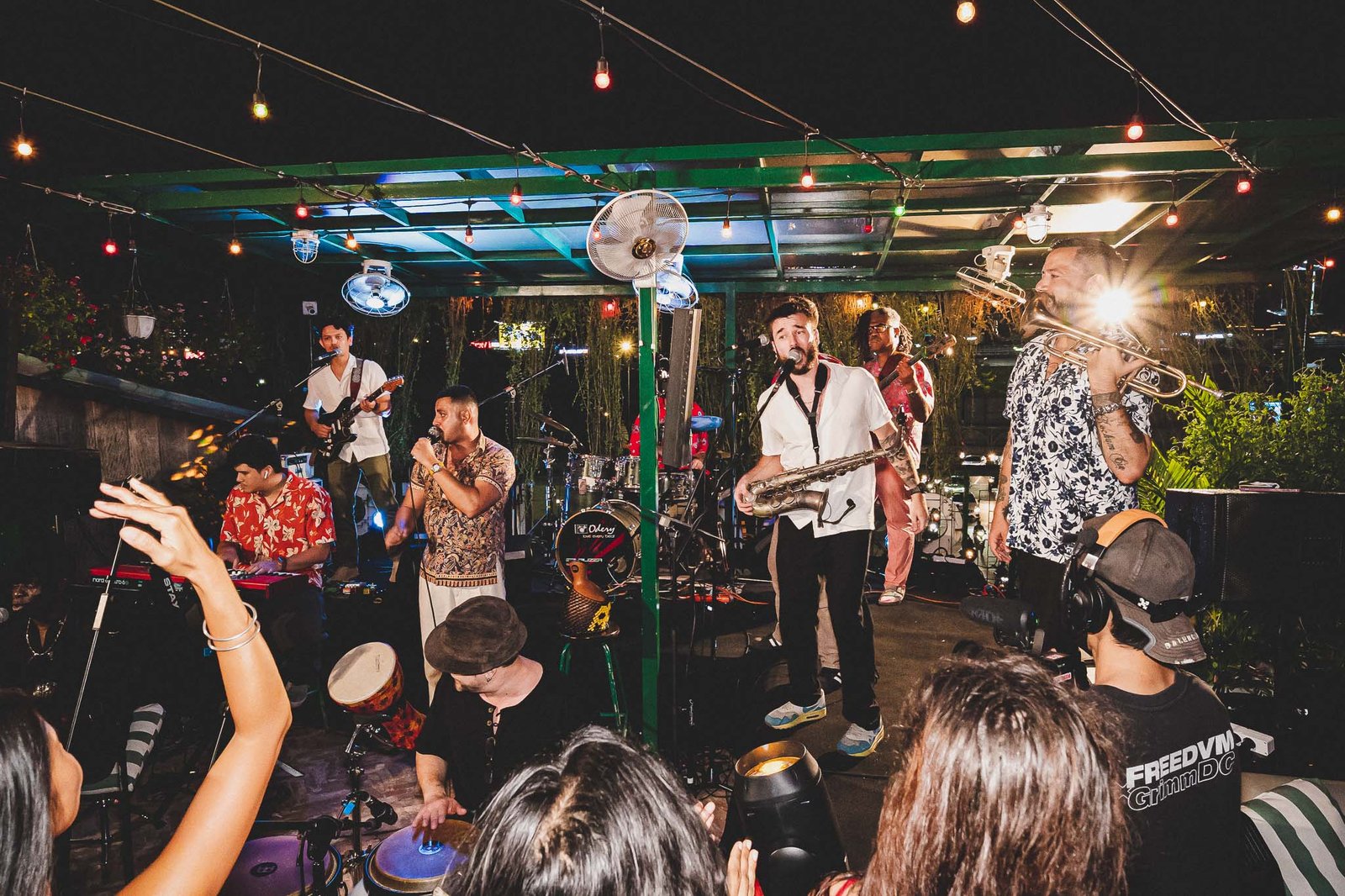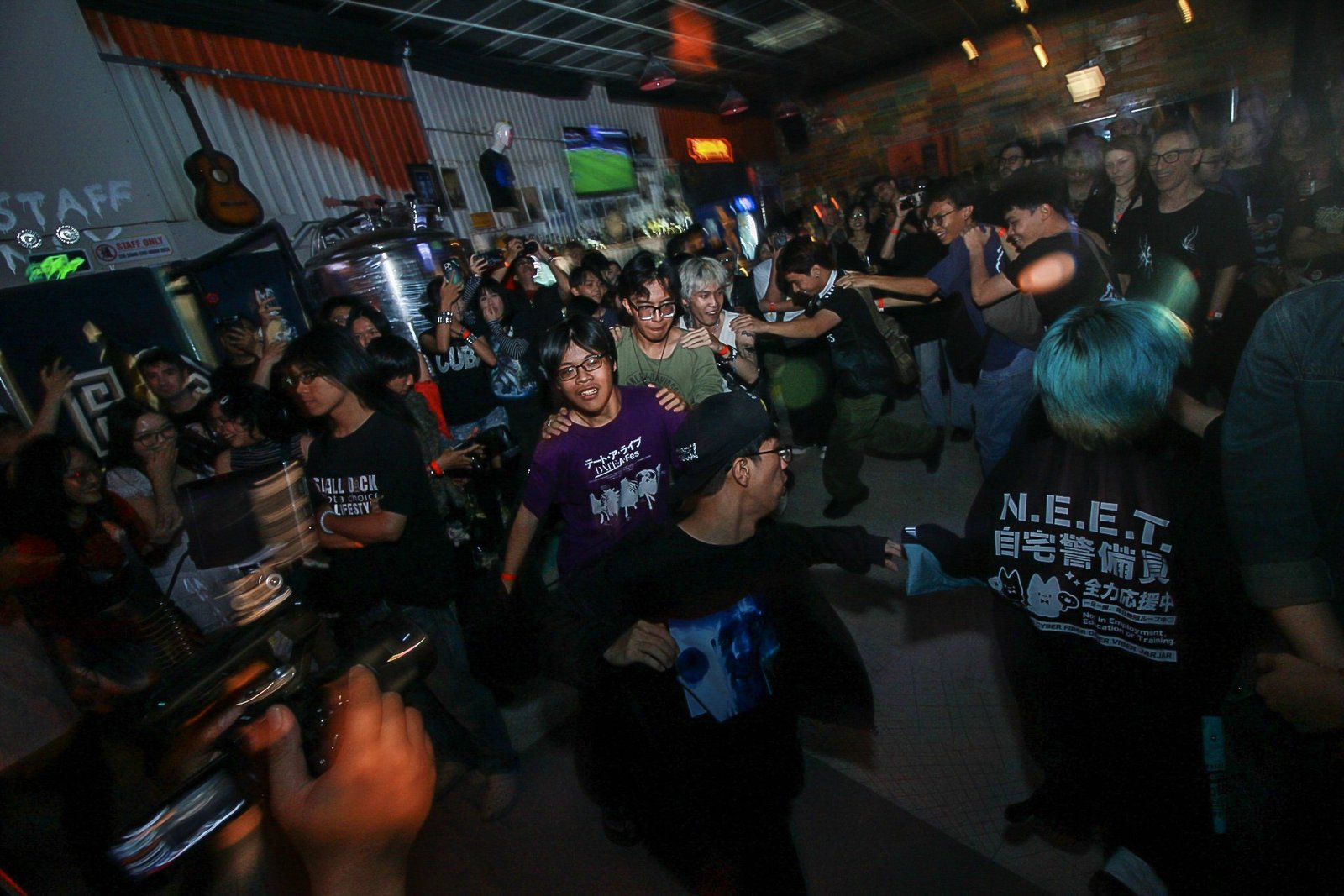
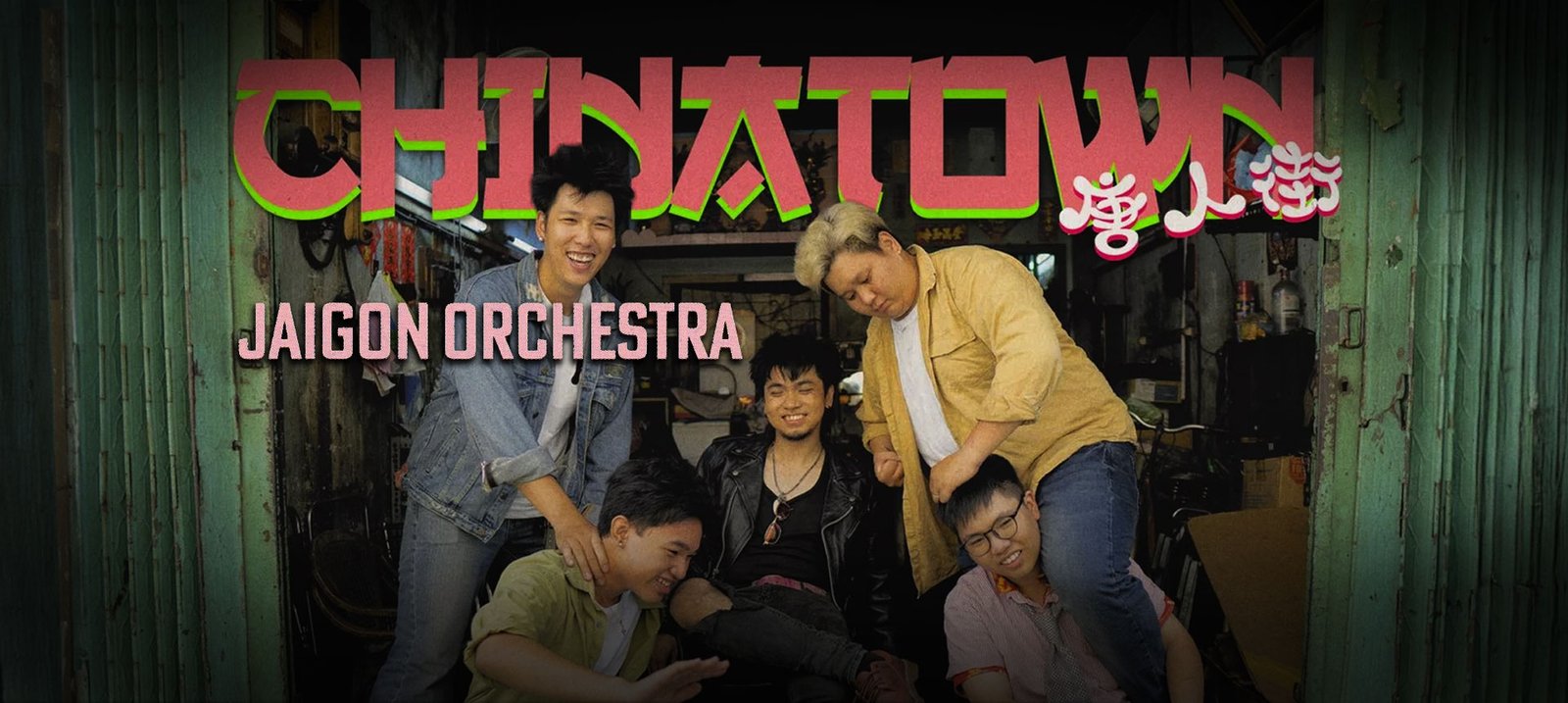
Saigon’s Jaigon Orchestra never stayed still. Born from a love of ska, punk, and big-screen theatrics, the band built its identity on outsized arrangements, pop hooks, and a taste for spectacle. From early sugar-rush singles to a bold My Chemical Romance–inspired phase, and now into an 80s Hong Kong palette powered by Cantonese rock memories, their story is equal parts craft, instinct, and community.
We sat down with frontman and producer Kiệt Trần in his studio to talk about everything: the name, the lineup shifts, how melodies arrive on motorbike rides, why “Công Bằng Cho Người Buồn” marched like a steampunk parade, and how “Chinatown” became a million-view love letter to District 5. What follows is a conversation about growth, grit, and trusting the process.
Beginnings, Mentors, and Lineups
Ethos:
The first question is very basic, and we’re very curious about it. Can you explain the name of your band okay? After Googling Jaigon, we couldn’t find anything.
Jaigon Orchestra:
Okay, I will do this one more time. It’s like Saigon, in Japan. When I started this band, I started it with Kore. Not sure if you remember Kore, a Japanese guy. At the beginning, he played drums and I played guitar. When I asked him what would you like to do with the name, he said whatever, but just put the Orchestra. I mean, we tried to do ska. At that time, I was also big into Tokyo Ska Paradise Orchestra. You know, a big sca band from Japan. Him and I were inspired by that.
E:
How did you guys start? Where did you guys meet?
JO:
He was like my mentor. He helped me with the studio back then in 2018 or 2019. Back then I was focusing on producing and making music for other people, but I never really did my own thing. And when I started to get more into that, I asked him to make this band with me.
And then after that, COVID hit. And he went back to Japan. Luckily, I found Jason, and he joined the band.
E:
How many lineup changes have you had so far?
JO:
There were three drummers, four bassists, a saxophonist, and a trumpet player in the end. They were never out of the lineup after joining.
E:
How did all these lineup changes affect your sound?
JO:
Not that much. You know, usually I make the song with a lot of backing tracks. And when we went live for the first it was kind of empty. Because when I make the songs, I always try to make them bigger and bigger. And when on stage with just guitar, bass, and drums, it’s not the same. So I thought to add some horn session players in there and make it more interesting, and make it really ska-like. Like the bands from the US or Japan. Just so I don’t have to put up a lot of backing tracks. To make less work for myself.
Building a Giant Sound
E:
Where does this influence come from? Who played you Ska to begin with?
JO:
I just love the sound of orchestration. I just love the sound. If I had enough money, I’d love to get the whole orchestra, because I love everything. You know, just like a theater. I love the theatrical stuff. Everything sounds big!
At the time we started, I also wanted to play punk with that kind of orchestration. Very few people in the world do that. That’s why I wanted to do that. It just sounded very interesting to me at that age.
E:
What about J-pop and Cant-pop? Some of the songs from your debut album sound like they came straight out of a manga.
JO:
That’s exactly where this comes from. Also, because I started the band with a Japanese person. At the time, I listened to a lot of Japanese punk rock. Things like Locofrank, Hi Standard and Dustbox. I listened to a lot of d-beat and I love that shit. So I tried to master it with that first album, because in my mind, I felt like maybe after this album, I’ll get bored with that and then I can move on. So I have to play all my heart into that.
E:
Can you name three of the favorite artists? Which ones had the most influence on you as a musician?
JO:
Ohhh, it’s gonna be so different! (hahaha) Avenged Sevenfold is probably the biggest influence. Then My Chemical Romance. because they sound, like I said before, very theatrical. And third… Uhhh it’s so hard to pick only one. I have so many coming to my mind now. But let’s say Billy Talent.
E:
What’s your favorite Billy Talent album?
JO:
Probably everyone’s favorite, their second album, “Billy Talent II”. I “stole” a lot from that album (hahah). I even have that one part in “Chinatown” that sounds like “Fallen Leaves” (hahaha).
E:
Can you open your preferred streaming app and tell us what your top three listens are currently?
JO:
Hmm, Johnny Pandora, Japanese rockabilly guy. I get influenced by him a lot, too. And then, there’s a lot of Beyond, it’s a Cantonese band from back in the day from Hong Kong. The singer died a long time ago. It’s my neighborhood’s favorite artist. People play it every day. And Billy Talent (hahaha).
The Songwriter’s Road: Melodies On The Bike and Soundbites
E:
What’s your writing style? Because a lot of people just start from some simple chords and then build from there. Is that how you do things, too?
JO:
Recently, I write my melodies in my head first. (hahaha)
I try to sing it and record it on my phone. Always when I’m on the bike. I pretend like I’m on the phone with somebody, but I’m actually singing the song to the phone. (hahaha). Then, when I come to the studio, I take the guitar and I just try to add the words. When I was younger, I did it like everybody else would do. I make a chord progression, and based on that, I try to write the whole song.
E:
Do you instantly hear everything, like all the orchestral parts, or do you hear just that main melody?
JO:
Mainly I just hear the melody. But sometimes, in my sleep, I can hear everything. Yeah, I can hear everything.
Kíp Đào Hoa: Cheerful Sonics, Vulnerable Lyrics
E:
Let’s go back to your first album. It’s pretty long. It’s pretty cheerful music-wise, but then the lyrics are very personal and it’s mostly about your relationships. How was it shaped, and was it hard for you to be honest in that way?
JO:
You know, at that time, I was just a broken boy. Back then, I love to feel the love around me. Mainly from females (shy laugh). I think everybody does at a certain point. On one occasion, when I tried to be honest and express my feelings, a lot of things happened, and maybe I cannot really talk about it. But it affected me in the way that, at that time, I felt like not loving anyone anymore. Like, I lost trust in almost everybody. When I’d try to approach someone, I would think about it a lot. Is this a good person? Who do they hang out with? Sometimes people are very sweet and stuff, but that whole situation I’ve been through just got me thinking a lot.
And then, I didn’t know where to put those emotions. So I just tried to make an album about that. But out of those 15 songs, 5 or 6 are very personal, and the rest are like fillers or something (hahaha). They do have the same concept. I tried to write about a person, put a name in a clever way that’s not that obvious. Something like that.
E:
Out of these main 5-6 songs you mentioned, did you start with the lyrics and then compose music to address your feelings, ordid you already have music, and then you just figure out which song would fit the lyrics better?
JO:
For that album, I was more of a music composer. And then I would try to make the lyrics relevant to myself. But I knew from the start, these 5-6 songs are going to be the main songs.
An MCR Homage, Saigon Style
E:
That could be called your first phase. You all had colorful hair, and everything was very cheerful. From there, you go straight into gothy territory and the whole My Chemical Romance thing.
What was your main intention behind that project? Did you want to tribute them as a band, their theatrics, the costumes, the music?
JO:
First thing, of course, was the fact that I wanted to pay tribute to my favorite band in the world. Also, another thing I really love is steampunk. I love that thing to death! When I’m looking for games to play, I’m trying to find a game that has that setting. Depressing, a lot of steam and a lot of mechanical robots, and stuff.
E:
Was that kind of a challenge for yourself?
JO:
I think so, yeah! Of course, because I know I’m not going to do as good a job as My Chemical Romance, but, like, their was the original one.
We call that the “Shopee version.” (hahaha)
E:
We wouldn’t really agree. The video and everything are done really well! How much time and resources did it take to make it? And would you change anything now, looking at it from this perspective?
JO:
It took us around two, three months to make it all. The first month, we were chasing sponsors, people to be in the video, locations, etc. Then we filmed the next month and took a longer break for the Tết holiday. And then the month after we finished all the post-production, mastering, and have released the video.
We already had the music before we even started working on the video. And that’s the only thing I’d change about it. I would focus more on the music and how the video follows its pace.
E:
Obviously, this is not a cover song; it’s just visually the same. What was the inspiration for the track?
JO:
I wrote the music during COVID. At that time, I was thinking about the first album, and it is all about love, male-female relationships, and I got kind of bored with it. (hahaha)
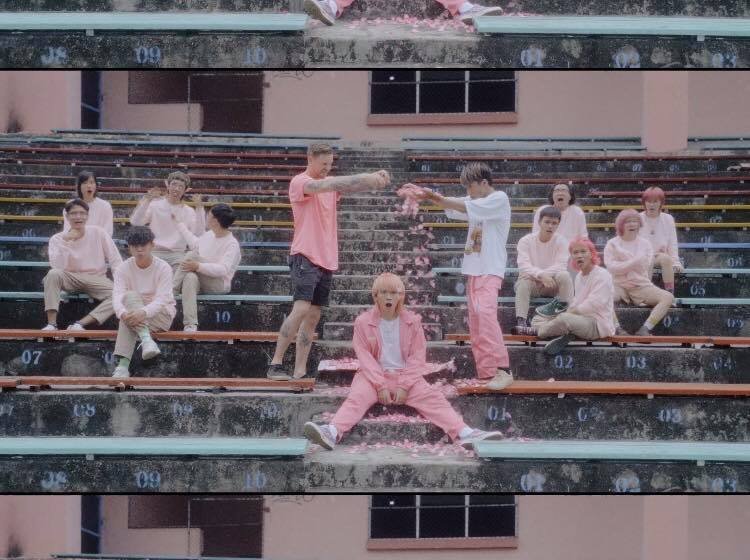
So I started thinking about how people love to complain a lot about life. Usually, it’s not because they tried to make it big, but not anything big, the way they look at things. So that was the subject that inspired me to do that music. I tried to make it cheerful, like a parade. Something you can march on. We took the whole steampunk gothy theme, but turned it into one that’s colorful.
E:
Have you tried to share that video with My Chemical Romance?
JO:
No, we haven’t! Maybe we should try it now. (hahaha)
From Colorful Hair to Neon Hong Kong
E:
From colorful hairstyles, cheerful ska, steampunk, My Chemical Romance, now we come to your latest iteration, “Chinatown.” What’s the story behind this change?
JO:
“Chinatown” was a return to my roots. The first two records, I chased things that are not really me. I try to look more around myself. And I noticed that nobody knows about the place I come from. The songs that surrounded me. People in my neighbourhood (District 5, TP. HCMC) always listen to the Cantonese music, they don’t really listen to Vietnamese music. This is their culture.
One day A Dính and I were in the studio, and I made that intro guitar part, because I had it in my head while I was driving. Then I made the beat, I made the instrumental parts, and when he heard it and started singing, what’s now a song chorus. And just like that, we had the complete track within some 30 minutes.
E:
So basically, your surroundings, family, and neighbours instilled this in you?
JO:
Pretty much so! Everybody listens this kind of music every morning. Whenever they do karaoke, it’s those songs too. So I guess my whole life, plus 30 minutes of work, made this hit. (hahaha)
E:
You guys hit 1 million views and counting. What’s that like? How does it feel to reach this achievement? And, did anything change?
JO:
Unreal! We weren’t expecting anything close to that when we wrote the song. I knew it was gonna get some attention, but I didn’t expect it to be this big. Now everybody knows my face. The cơm tấm lady across the street where we ate earlier, my living area, all of the Districts 5, 6, and 11, and all my favorite restaurants know me already.
E:
Did you hear your song around your area, someone blasting it at their house?
JO:
Not me personally, but my friends have. When I go to the billiards club, as soon as they see my face, they just play the song, and everybody is looking at me. (hahaha)
E:
How does that feel for you personally? Are you proud of yourself? Or do you shy away from it?
JO:
I think it’s a little bit of both, you know. My friends know that I don’t talk a lot. I am usually a bit introverted. When we were making the video, I had to go to the street and dance. I was so shy. I asked if we could do it in the house. And they were insisting, saying it’s not too long a shot, go and do it.
I wasn’t really comfortable about it, because I didn’t feel like that’s the right setting for me. When I’m on stage, I feel very confident. But outside of the stage, I’m scared of doing things in public. It’s weird, but that’s how it is.
Of course, I’m proud. We went a long way and did a lot of stuff over these five plus years and now we got this – our biggest song to date. So yeah, I’m definitely proud.
E:
What’s next for you guys? Do you already have some new songs prepared? And if so, are they in a similar style to “Chinatown” or?
JO:
We will release one more single and then we’re going to drop the whole album this year. But nothing sounds like, “Chinatown.” I tried to, but I love a lot of music. I cannot stay in one style of music and play that forever. If I’m going to do the whole rockabilly album, maybe it’s going to bore me. So would go out, and try a lot of stuff. Maybe some ballads, or maybe some trendy rock music, like Falling In Reverse. Right now I’m really into their sound. We always try to experiment with our music without limitations and see where it leads us.
TỤP TẮC Records: Family, Not Competition
E:
All of your videos are very well done. Seems like everything is thoroughly thought through. Who comes up with the concepts? Does it come from within the band, or do you let directors do whatever they want?
JO:
I absolutely let the director do whatever they want. Sometimes I just say some of my ideas and if they like it, maybe they put it in there. But I always trust their vision. Because that’s what they do, they know better than me. I feel like it’s not my specialty. So I don’t try to tell people how to do their job. It is in my mind, I put more of my input, but in the end of the day I always trust them. And so far, they always make the best ones for me. (hahaha)
E:
From our understanding, most of your videos are done by your friends. Correct?
JO:
Yeah! My friends have always done our videos. There are: Tsoul Duy, Huy, Dính, Anh Trí, and Hồ Việt Quân, five of these guys do all of the Jaigon videos.
E:
You’ve mentioned a few familiar names. Ones that are involved with TỤP TẮC Records. It seems like this is more than just a label you guys are running. It’s more like an incubator for musicians. You hang out together a lot, and you work on each other’s music and videos.
Is this bond on a pure camaraderie level, or is it more of a friendly rivalry? Does it make you all work harder and improve your skills?
JO:
We do have a friendly rivalry, but not in a way that we compete with each other on who can make a better song or a video. For example, when I see one of my friends got a better guitar, I think to myself, “Hmmm, damn, maybe I need to buy a better one.” Or if one of them buys the Kamper (amp profiler), I need to get one too. (hahaha)
So we’re competitive in that way, who has better gear. But the music we always mix together. My song is their song too, and the other way around. We always try to help each other to make the best song possible. If I write a song, but I don’t feel like singing it, and I know someone else is gonna do it better than me, I would give it to my friend. We also try to do the writing session together. It’s pure friendship for us. There’s no rivalry in the creative process whatsoever.
E:
How did it come to this? Music can be very personal. Ego can be a big issue when it comes to writing music. How did you guys overcome this and become so open with each other?
JO:
It goes back to what I said to you before. When I write a song, it’s just my perspective about one thing or topic, and I want to know if people around me who experience the same thing as me, how do they feel about it. I always ask them about things to get more perspectives, so we can make a lot of different things. If I do Jaigon by myself, it’s going to be easy. Without anyone telling me what to do and what not to do is kind of boring to me.
I love to hear about people’s opinions about me so I can do better. After all these years, when someone makes success, I feel like I’m successful with them! If 7Uppercuts succeeds, I have things to do too, so that’s good for me. And if I achieve some success, I got even more things to do. So even better!
E:
Nowadays, who is the main person that you go to with an idea to ask for an opinion?
JO:
It’s usually A Dinh and Aki. Those people know me well, about my thing, even my personal life. They know about it, and they understand, so they can get the most out of it with that view.

Producer vs. Musician
E:
How do you balance being a producer and being a musician? Do they affect each other?
JO:
I still try to balance it, but I still lean on the producer side more than the musician. That is my main thing to do. That’s how I support myself, that’s how I get money to pay the rent and stuff. Hopefully, in the future I can make it good with Jaigon, so I can do less producing and make more music with my band.
E:
When you’re working with different artists in your studio, does your musician side kick in? As in, do you often make suggestions to the artists on how to arrange their songs, what to avoid, etc?
JO:
I always try to work things together with an artist. Talk about everything. I can suggest how to do this or that to make the song “better”. If not, I can always switch to the other side of myself and do whatever you want. So it’s up to the artist. I don’t go crazy to have it my way.
E:
Which one do you prefer?
JO:
I prefer the option in which I give more suggestions. Because it makes my brain think, makes my brain work. Which is always a better thing.
Stages, Cities, and Secondhand Markets
E:
Let’s talk about live performances for a second. Is there one that is very close to your heart? Maybe your first show ever, or the one with the biggest audience?
JO:
I think the best, and one that’s very dear to me, is Jason’s farewell show. That one was very, you know, very emotional for me. Like I mentioned earlier, he was starting to get more Asian than he could be. (hahaha)
Also, I became closer to him than ever. After two years together, I felt like we had become real friends. with each other. So it was very sad that at that time he had to leave. But I also feel happy for him because he found the love of his life. They had to go back and do their mission in life. And I’m very happy for him. He’s like me in a way, a very disciplined person and, also very shy person. So I asked him to do the stage dive at that show. People had to cheer “Jason, Jason, Jason!” And then he got to do that. It’s good, good memories.
Also, the album release show. These two are very dear to me.
E:
You also played in Thailand and Taiwan. How was that experience for you, and was it in any way difficult for you guys since all of your lyrics are in Vietnamese?
JO:
I don’t know, because I never asked them about that. (hahaha)
I just feel like I’m so lucky. Why do they ask me to play there? Thailand was maybe a bit more difficult. Thai didn’t speak much English. But they’re very nice people. The first show in Bangkok was a bit empty. The surprise was that there was one big fan of ours in Bangkok. I was surprised as he was just sitting and waiting there. Turns out it was a Vietnamese exchange student. We didn’t know him before that. So the surprise was because not a lot of people in Bangkok come to see the show. Only the artists who played. So we supported each other. Was a good fun!
Next show we had was in Korat, some three hours from Bangkok. That was much better. We played at a secondhand T-shirt market. That was awesome! A lot of people coming around to see us too. They didn’t know anything about what I’m saying, but we still play. They understood the music and they were happy. They cheered for us, so it was awesome.
E:
Did you get something cool from the secondhand market? (hahaha)
JO:
No, but some guy just gave me a construction jacket. (hahaha) I still keep it at my home.
E:
How did those shows compare, from your subjective opinion, to the shows here in Vietnam?
JO:
I think Vietnam is very supportive in situations like this. When we bring some foreign acts here, I feel very proud of our fans. They cheer for anybody, even the people they don’t know; they still cheer for them. When we were overseas, it was not always like that. Maybe because of the language barrier or something.
But I am very proud of our audience. When we played Bangkok with ĐÁ SỐ TỚI and another Thai band, maybe just ten people came to see the show. After that, we brought that band back to Vietnam, and there were 400 people. Of course, the guests were so happy. They never felt like that in their life.
E:
Did you get the impression that Thailand is maybe a bit oversaturated with shows? There are a lot of things happening there. Maybe that was the reason for the lower attendance at your shows.
JO:
I don’t really know about that, and I can claim that to be true. I think Thai people love to go to big shows, not the small underground shows. There is a lot of that happening in Thailand and everyone is so good at what they’re doing, so it almost feels like no one is good enough; people can’t decide who to see first. Even the punkest bands sound so clean and tight. Not dirty or raw at all. It’s just how I feel, can’t say that’s a fact.
For me, going out of Vietnam is a vacation. If I can play, great; if not, still good.
E:
Would you recommend any of the SAE bands you’ve discovered on your travels?
JO:
I love Taiwanese bands a lot. The guys who played in Saigon recently, Un Avec Deux are gerat. Their guitarist recorded our show in Taiwan! Also, Yuki’s band, Broken Flowers. There’s more I just need to remember them all.
E:
How about Vietnamese bands?
JO:
Vietnamese? US (hahaha)
We are so underrated!
E:
Yeah, with a million views, you really are! (hahaha)
JO:
We need some more of that! (hahaha) I’m joking, I need to be humble.
What’s Next – Saigon Bites – Advice For Bands
E:
What would be your dream collaboration? Anyone in the world, living or dead!
JO:
I would love to be on stage with My Chemical Romance. I’m going to see them next year in Malaysia, so maybe! (hahaha)
That might be too big a dream. But for collaborations… The list is so long! Too many names. Maybe M. Shadows.
E:
What is your favorite dish from Saigon’s Chinatown? What should people go right away and try there?
JO:
Uhhhh… I have to choose carefully. There are a lot of great dishes there. For starters, I never get bored of egg fried rice. You can get it anywhere in the world, but in Chinatown is just the best.
E:
Any particular spot?
JO:
Just go to any shop in District 5, 6, or 11 and you’re good! Also, Sủi cảo! Got to love that! And of course, Dim Sum, got to try every kind of it.
E:
Last question, a very regular here – What’s your advice to young bands starting in 2025?
JO:
Just trust the process! Don’t rush success and stuff. Don’t chase that ever. Just play out of your heart and that day will come. I truly believe that.
You can’t go to the gym one day and you become Schwarzenegger! You’ve got to trust the process. It’s gonna take months, years. You still have to be patient and things will come. Don’t think about money and fame first, that will come later.
TRUST THE PROCESS!
Jaigon Orchestra’s arc is a study in movement: from ska horns to cinematic emo, from personal heartbreak to neighborhood anthems, always going bigger without losing the pulse of the street. “Công Bằng Cho Người Buồn” showed how homage can unlock new language; “Chinatown” proved that the most resonant ideas often live right outside your front door.
Kiệt’s compass—melody first, experiment freely, trust your people—explains why each era sounds distinct yet undeniably Jaigon. As they roll toward a new album with zero interest in repeating themselves, one mantra echoes from studio to stage: trust the process.