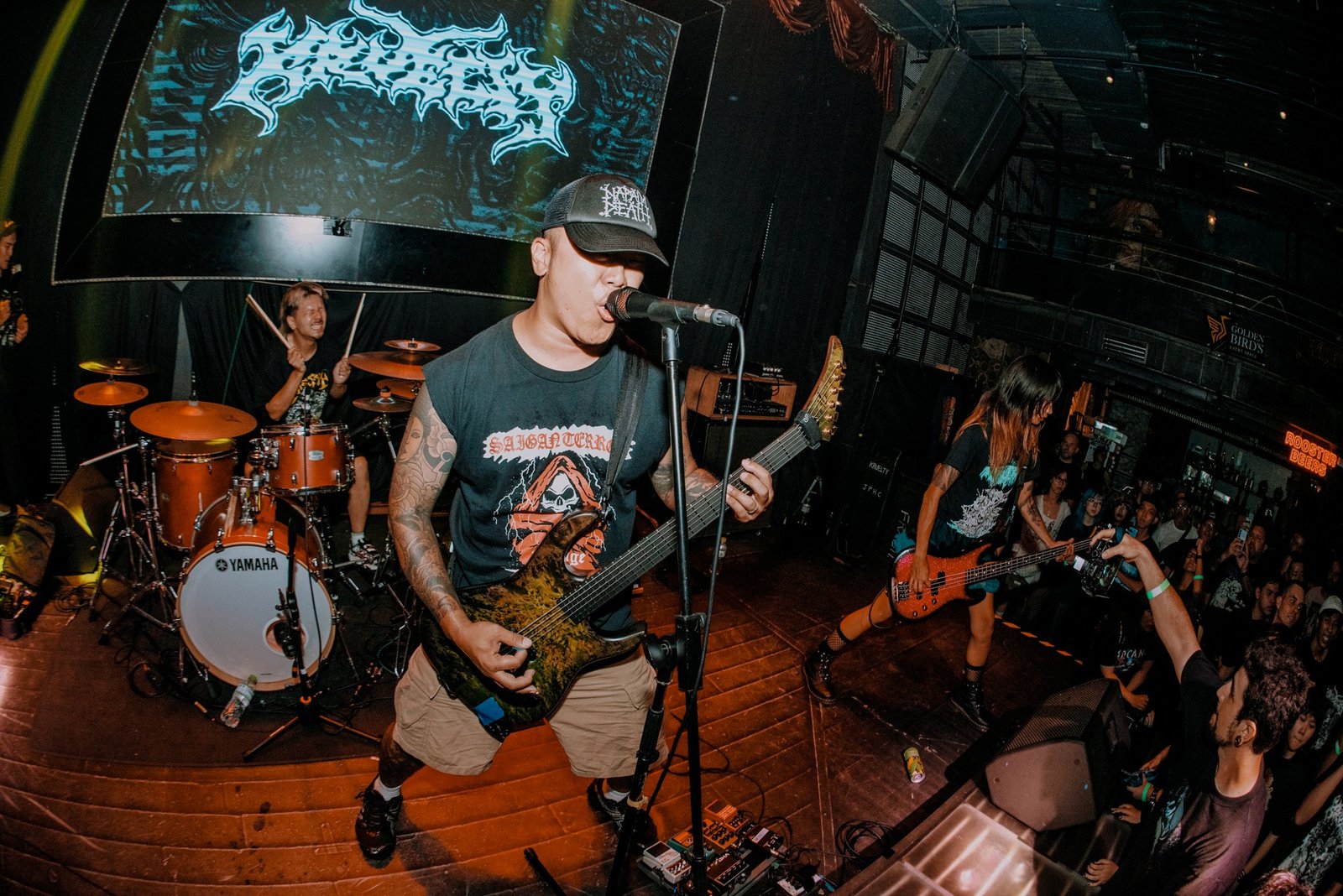
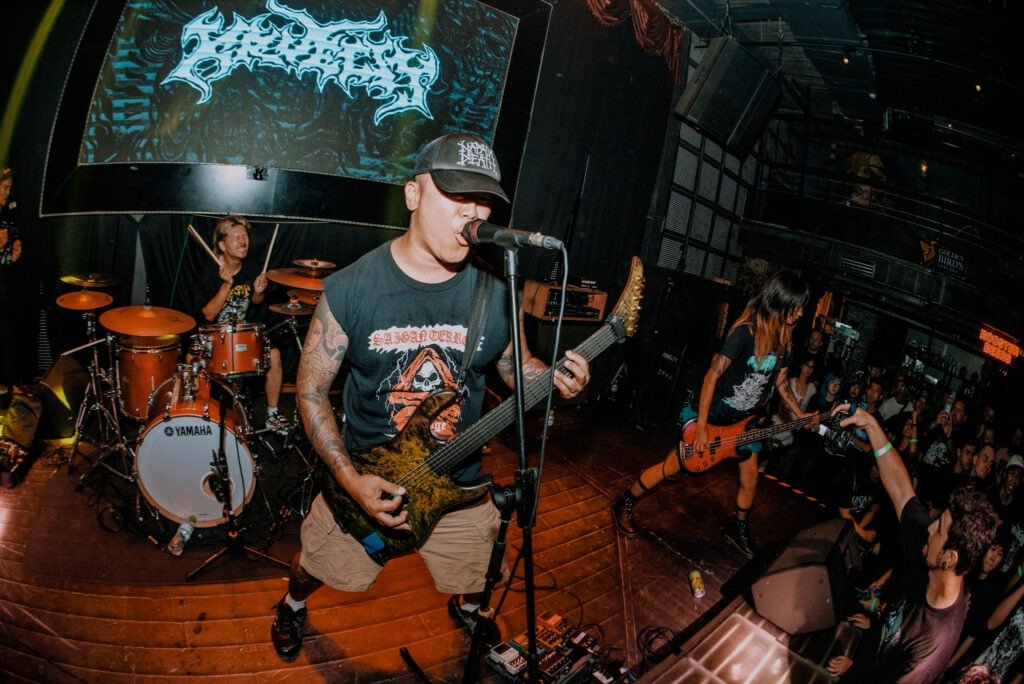
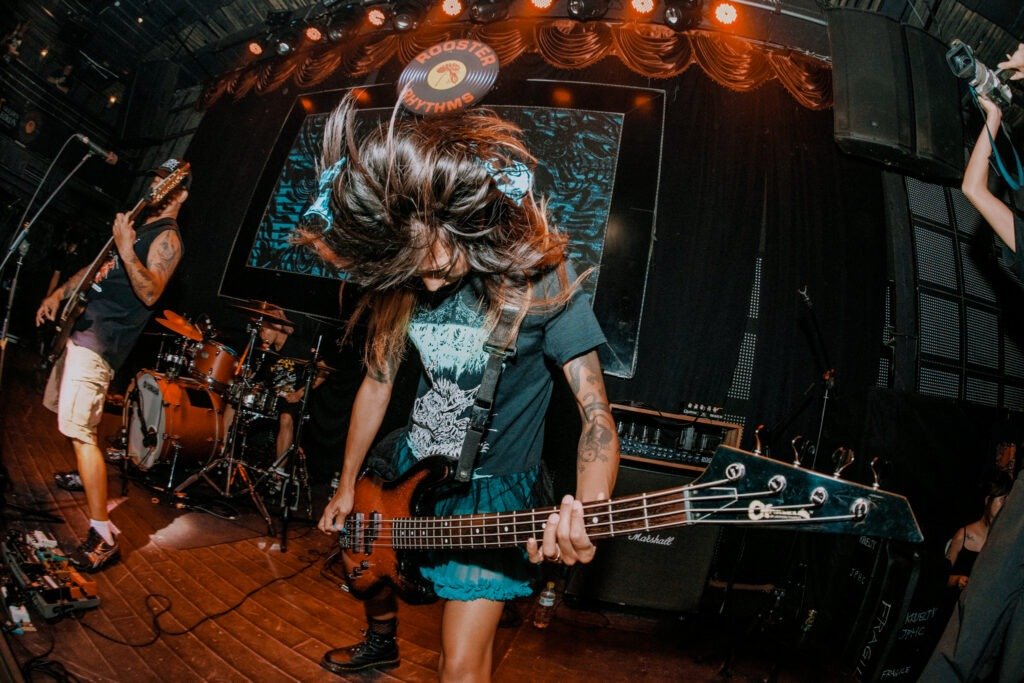
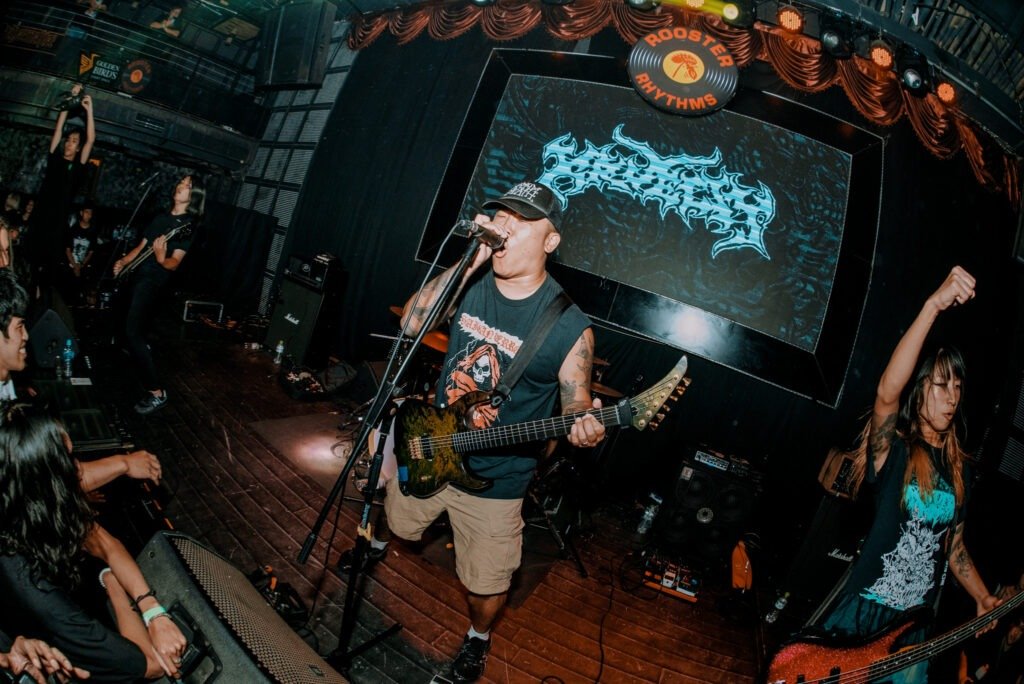
Kruelty’s recent performance in Ho Chi Minh City left a deep impression on both longtime fans and first-timers alike. With a crushing, uncompromising set and an attitude that balances DIY grit with clear purpose, the Tokyo-based band proved why they’ve become a respected name in heavy music circles worldwide. Beyond their brutal riffs, it was the group’s openness and grounded personalities that truly resonated, earning them a wave of new support in Vietnam.
Formed in 2017, Kruelty have steadily carved out their identity as one of the most distinctive acts blending hardcore energy with death metal intensity. Touring globally since 2020, they’ve remained productive despite a demanding schedule, releasing a solid stream of material and collaborating with respected names like producer Taylor Young. With no frills, no gimmicks, and zero pretense, they’ve built their career by staying real, working hard, and keeping the amps loud.
Death Metal Roots, Hardcore Edge
Ethos:
Can you give a short introduction of your band for people who don’t know about you? A bit about your musical background, and everything one should know about Kruelty.
Kruelty:
We formed in 2017. We are called Kruelty, yes, with a K instead of a C. We’re from Tokyo and started as a band that wanted to focus on heavy, hardcore-infused music. At the time, we were into, of course, metal, also hardcore, you know, any kind of old school heavy music. So we started as hardcore, but with a lot of metal influence in general. We did our first album in 2020 that’s basically where we started. We started touring internationally. And then, our first big tour was in 2022 in the US. That was very successful. After that, we got more opportunities to tour many countries. Since then, it’s been three, four years of touring anywhere and everywhere. And now, we have finally made it to Saigon, Vietnam.
E:
Welcome to Vietnam! First thing first, in our opinion, you’re the most death metal hardcore band, currently. You mostly play hardcore festivals and hardcore shows. How did it come to that, since your sound is obviously leaning more toward metal?
K:
I personally grew up listening to metal music. When I was 18, I saw a “mixed bill show” with slamming death metal and also heavy hardcore bands like Hatebreed style. My favorite at the moment was straight up death metal. So when I witnessed a hardcore show I was like, “Bro, this is fucking crazy!”. Then I got hit in my fucking head but realized everyone’s doing the same thing and everyone’s happy. I was questioning, “what’s going on in here?” But during that show I got to make friends with people that are the same age as me.
I was able to have more fun at hardcore shows than metal shows in Tokyo. Because at that time I was also going to a lot of metal shows as well, but these shows were mostly filled with older dudes. You know, death metal, thrash metal fans at the time were almost exclusively filled with 50 year old guys. I was enjoying that music, for sure, but it wasn’t as fun without friends to share the experience with.
So I always wanted to do this kind of heavy music, but for people closer to my mindset, hardcore kids and stuff. And then coincidentally at the time, this kind of style popped up anywhere in the world. So I thought to myself “Oh, this is the right timing!” Our first EP and the first LP were more leaning on the hardcore and beatdown side, and we slowly started putting more death/black metal and grindcore from the second LP.
And this is where we are now!
Tour Life, Teamwork, and Making It Work
E:
Your band’s been around for eight years now, and your catalog is pretty extensive. Once one starts digging into your Discogs, they can see a bunch of collabs, mixtapes, and, of course, your official EPs and LPs. How did you manage to create such output in such a short time? Especially with the extensive tours you guys have been doing.
K:
Obviously, in the last three or four years, we have been busy touring, but we are always trying to do at least one piece of music a year no matter how small or big the material is. Two songs, a single, whatever is fine to me. I’m just sitting at my desk almost every day when I’m not on tour and I’m writing music.
Luckily for me, even though I still work, it’s not a 9 to 5 job. I work remotely, so I just need to email some people, but nothing crazy which means I have time for everything I love to do. Yeah, sometimes I have to work at 2 a.m., even when I’m on tour because of the time difference but for now, I’m pretty happy with this lifestyle. It’s not gonna make big money, but I don’t really care; I value my free time more. I think anyone who comes to our shows would agree with this. I don’t want to be fucking rich with a crazy amount of work. I know some people around me who have big money, but they’re working 14 hours every day. The working culture in Japan is kind of absurd. You know it’s hectic. You might die for this. Where’s the fun?!
E:
Since you’re the one writing all of Kruelty’s music can you walk us through your work process?
K:
The process is pretty much straightforward. I’m just sitting in front of my computer, writing everything on ProTools. I program drums, and then I share it with other members. Then we can just go from there. That’s the reason we don’t take much time to make songs. I have a bunch of friends who are doing it the old school way, showing up to practice, jamming together and making songs. That takes forever, because it depends on the band; everyone has an opinion. I mean, don’t get me wrong, that’s cool too, making songs through discussion. But, realistically, we have and want to tour, and if you want to put out music and make a name for yourself, you need to be able to make songs in a short time. So I think my way is more suitable for this band, at least. Obviously, it is working!
E:
Does your wife get involved when you’re writing new stuff? *For everyone who doesn’t know, Zuma (guitar/vocal) and Seina (bass) are married to each other.
K:
Yeah! But more like “Oh, that’s too complicated for me.” But most of the time she’s cool with what I write.
E:
Does being married to a band member make things easier, logistically speaking?
K:
I think so, yeah. Because writing and organizing our time for touring is simpler. We meet a bunch of bands touring, and when asked about this particular thing, a lot of them are like “Ohhh my wife is mad that I’m leaving for two months”, and it makes sense. In our case, nobody is leaving. Also, we often go on vacations right after the tour. If we go to Australia, we can just drop in at Bangkok, Bali etc.
E:
Does it have its downsides? Maybe some arguments that are not related to the band spill over to the band and vice versa.
K:
Not really. For now, we haven’t had anything crazy, which is good! Maybe if on a show I fucked up on something or she fucked up, we might have small, small argument. But we go to the hotel room, go to sleep, and after waking up in the morning, we forget everything. We got to do better just for tonight, for today. Some people are thinking too much about the past. I know we can go back to yesterday, but you can make today better.
E:
Speaking of yesterday, your sound is very traditional compared to the “modern” bands. Do you still go into the studio even for smaller releases, say a single or an EP, or do you do that in the home studio and just get tracks produced remotely?
K:
When we record proper albums, we do it in the studio. Our last two albums were completely recorded and produced in the US. Because we’re focused on the Western market, I believe doing the recordings there helps and makes it better to get more attention over there. People from the states or Europe can see who produced the record and go like “Ohhh, I know that guy, I need to listen to this record.”
For the demos and EPs, we mostly record at home. I can track drums at a practice space, I dub guitars and bass, and then I send the stems to the producer in the US.
E:
We know your last few records were done by Taylor Young. How did you get to him, and what is it like working with the guy? He’s a legend in these circles.
K:
We started working together since our first LP. I think he has done five of our records so far. Maybe more. At the beginning of 2019, when we tried to put out our first LP. Of courseI knew him from his records. Eventually, I messaged him on Instagram saying, “Hey, you want to mix our record?” And he said he knew us and he was down. We had a label from Japan called Daymare Recordings at the moment for the first LP, so they could budget the mixing cost which was a lot for us at the moment. That’s how our relationship started. We recorded the first LP in Tokyo and he mixed everything. And this other guy called Brad Boatright, from the US, mastered the record.
E:
And after that, you went to the US and recorded there?
K:
Yeah that was actually our first tour in the States in 2022 as I told you. We started from Massachusetts, down to Florida, and then we flew to California, had four shows there (they were amazing) and then we went to his studio and had our recording time.
Recording probably took a week or so for that session. It was our first tour, so all of us were fucking exhausted, but we were all so happy with the outcome of the tour, and then we were like, “Okay, now we are ready to record.” This is not normal for any Japanese bands, so we all were beyond stoked.
So yeah, we were happy with that. Recording was tough. He’s not super strict, but obviously there’s a language barrier for other guys. And then, we didn’t have so much time for practice, but still that was a fun recording. It was a good experience.
E:
How did it affect you? From a perspective of, “Ok, now I know what to do for the next one.”
K:
After the 1st LP he started understanding what I do or do not like, sound-wise. Also I realized, this way should be faster for recording something. Because the way we recorded with him was different from what I knew. We had a lot of material already, even before the first LP. A bunch of EPs and demos and stuff. But the one with him was our first actual cool recording, with an actual good producer who has good mics and setup. So yeah, that was a good experience for me to learn how things should be done during a recording. Since then, we could manage ourselves to save time for recording which can be less money obviously. Before that, I thought I knew a lot about recording, but I realized I don’t know anything. (hahah)
E:
Does your sound, especially guitars, in any way stem from his input? Because his work with Xibalba and Nails kinda resembles your guitar tone. You can tell that’s a tube amp, oversized cabs. It’s heavy!
K:
I think everyone in this kind of heavy music loves the same tone. Big distortion and scooping the mids. (hahaha)
E:
Can’t really agree on that (hahaha). Seems like it does come from a producer. Taylor’s work is much different from, for example, Putney’s.
K:
Yeah that’s true. Obviously I have a specific tone that I love. And I think Taylor knows what kind of stuff I’d go for. He’s very good at figuring out what musicians love. So without telling him that much, I think he understands what’s my favorite style. I didn’t have to really specify what I wanted.
On the second LP, we made a tone together because we recorded and mixed with him. For guitar and bass we didn’t have any hard time to figure out the tone which is nice! I would say he and I have different views when it comes to drums, so we had some time to figure out. But now we have done four or five records with him, so he knows what’s up already.
E:
We saw your rig earlier at the soundcheck. Is this sound you created in the studio reason you’re still carrying amps instead of modelers? This is quite an uncommon practice nowadays, especially for touring bands.
K:
I use tube amps when I can. And yes, we can’t carry those around for sure. But I’m still not into any digital stuff. What we are doing now is the best thing we can realistically do on tour. The amps we play are pretty small, but sound great. It would be great if we could carry or rent a massive Mesa or something, but I don’t want to pay much for that. I also know that it’s not easy for the promoters to organize a crazy amount of requested gear. Even if someone asked something like that from me when I book shows in Japan, I’m always like, “Dude stop. You’re not drawing thousands of people, so there’s no budget for that.” (hahaha) The amps we currently use (Quilter/Ampeg) are loud enough, and then we have some distortion pedals and stuff. We have been touring with them for almost two years now and we are pretty happy with the outcome. Not 100% perfect, but I guess it’s 90% perfect to me.
From Tokyo to Saigon: Global Grind and Local Scenes
E:
You obviously gained some traction worldwide. You said it yourself that your focus is more on the Western market. What’s your status in Japan? How well are you received back home? Is there a difference compared to the U.S or Europe?
K:
I think the underground culture is pretty small in Japan. There’s a huge gap in a way, either it’s Metallica or super small bands, nothing in between. North America, Europe or maybe Australia people who love big bands, also love medium bands like us, bands that play for 200 to 400 people. There’s a big fan base for that in each of those areas, but in Japan, it’s either stadium metal bands, or a 50-100 cap room.
I know where we’re from and we love doing shows in Japan, but realistically there are not many opportunities for smaller bands.
E:
Would you say that is the biggest issue with the Japanese scene currently?
K:
I think so, yeah. Metalheads from Japan are not really into the domestic scene, which is kind of sad. Big bands will not come if there’s no good local scene, but those people don’t really understand. That’s the only thing I’m not really happy with about our scene because when we go to Indonesia, Thailand, maybe here Vietnam too, we will see, normally these countries have good local scenes with full of respect from local people towards local bands.
E:
You mentioned several places you played. What is your favorite crowd so far?
K:
All the Asian countries are my favorite because I know it’s not common to have heavy shows with international bands in most Asian countries. Our China shows right before this show were fucking sick, and then Thailand is always great, Singapore is sick too. N. America is fucking crazy. Canada and the US, those two are always our best countries to go to because normally if we play the same country twice a year, people can go “Oh, I saw them a couple months ago already so I’ll pass.” but in Canada or the US, they’d still come to the shows. Those are probably the only countries that you can play as many times as you want and people will appreciate that.
We played Calgary in Canada which is not really a big city twice a year. Many people there showed up both times. They told us “I came to see you last time as well. Just four months ago. I know what you guys are doing. I want to support you guys.” which is amazing.
E:
Is there a standout moment that you would like to mention from the tour?
K:
I prefer playing small towns regardless of the country. In general, they don’t have many opportunities to have shows. For example in America, we just played in Nebraska and Kansas which are small, but people still showed up because they don’t have many shows. It was like all the heavy music fans in town showed up haha. I often ask if they knew about us and they usually just say, “No, but it’s a metal show tonight so I wanted to see what’s up.” That means people are supporting the scene there. Catching your favorite band is cool, but there are way cooler things when you’re just thinking about the scene of your area, your town, your city.
E:
What Japanese bands would you recommend to our readers? Some that people don’t know about. Something that’s not on the charts but should be.
K:
Right now off the top of my head, I’d suggest Tive. They’re a Turnstile kind of hardcore band from Osaka. I’d like people from Vietnam to listen to them. Or for something a bit heavier, FesterDecay is a good one. They’re a goregrind band from Fukuoka. They’ve just started touring. They had a US tour last year with 10 shows. They have good black metal kind of riffs as well as very intense drumming.
E:
This is your first time in Vietnam. What’s your first impression, and more importantly, what do you think of food here? We know you guys are into food wherever you go.
K:
Dude, eating is the most important thing on tour. Without eating, I’m not going to do a tour haha. We arrived here early in the morning, around 6 a.m. Then we had a Pho at 7 a.m. We followed Sergey’s recommendation and the food was fucking awesome. Then we just had a coffee here which is amazing. And we’re going to have a Banh Mi later. Maybe more to go.
E:
Do you have any knowledge of the local scene? We know your current guitarist did a collaboration with District 105 with his other band.
K:
District 105! I know about them, yeah. I honestly don’t know any other bands at the moment, but I’m going to check all the bands tonight for sure! We are not a rock star band at all lol. I know some even smaller touring bands than us can be behaving like rock stars, like sitting in the green room, never coming out of there until they play. And I’m always like “Fuck you!” to those people. You don’t draw fucking thousands of people, you know? Even if you do, still be nice to the local scene.
E:
Definitely check out KINH. That’s definitely going to be your cup of tea. A technical death metal, three-piece very tight.
K:
That’s cool! I’m pretty excited to catch all the bands tonight and then see the crowd from here. Happy to be here.
What’s Next: A New LP and Relentless Vision
E:
What’s next for you guys?
K:
We’ll try to slow things down after this tour. We need to write more songs because we’re trying to put out the third LP next year around the summer. We have to record everything by spring. But we only have two songs so far lol, so 6 or 7 more songs to go. We were touring so much last year, so we didn’t have time to write.
Then, after putting out new music next year, we are going to do a big, big tour. We want to play anywhere. We never played Hanoi, so maybe next time we will come over there. We are also trying to play every single small town in Europe or America. So, yeah, we will do the best we can.
E:
Last question we ask every band we talk with. What is your advice for someone who just picking up a guitar, drum, vocals, whatever, and starting their first band?
K:
Make friends with people or/and pick up instruments. You know, most people always say, “Oh, I can’t play instruments, so I’m going to do vocals.” Dude, we have so many vocalists already lol. It’s the same thing in any country. Maybe you should pick up drums. I guess it’s a deficit. You can play bass too.
Once you start a band, do a lot of shows! Don’t be afraid! Don’t be afraid to lose money because no bands can do tours without losing money at the beginning. You’re going to lose money from the first one, then maybe some small profit from the second one, but you have to try. Nothing happens without attempts. I just didn’t give up. Just keep playing and making music to see opportunities. Also do not forget to put out records. And don’t forget to talk to people at the shows in each city.
Kruelty’s rise is marked by consistency, clarity of vision, and a strong DIY ethic. From writing music in a home setup to recording albums in California, and from small-town US shows to their first steps in Southeast Asia, the band stays focused on what matters—music, connection, and persistence. Whether navigating the nuances of Japan’s domestic scene or planning their next LP, Kruelty’s approach is simple: keep playing, keep creating, and never act bigger than the crowd in front of you.
Their advice to newcomers says it all: make friends, play everywhere, lose some money, and never stop pushing.
Photos: Saxichuongduong